
Imagine you wake before the US markets open, see a sharp move in a mid-cap crypto, and want to buy spot BTC or an altcoin on OKX within seconds. The practical question is not whether OKX exists — it does — but how to get into your account, move quickly and safely, and what to expect once you trade spot versus margin or derivatives. This article starts from that concrete scenario and untangles common myths about login, security, and spot trading so you can act with clearer expectations and fewer surprises.
The guidance below is technical where it must be, candid about limits where it should be, and aimed at traders who need decision-useful rules rather than marketing blur. Expect specifics on the login surface (web, mobile, extension), KYC and 2FA friction, cold-storage protections, and how these operational elements interact with spot trading mechanics and risks in the US context.
Myth versus reality: logging in is the only security you need
Myth: « If I use a strong password, I’m safe. » Reality: password strength is necessary but not sufficient. OKX offers military-grade encryption, AI-driven threat detection, and mandatory two-factor authentication (2FA). In practice, security is layered: password, 2FA (SMS, Google Authenticator, or biometrics on mobile), device-recognition, and withdrawal whitelists. For US users, these steps interact with regulatory KYC, which means identity checks are part of the login-to-trading path.
Mechanism: when you sign in, OKX runs risk-scoring on device, IP, and behavior. High-risk triggers can invoke additional verification or temporary locks. This reduces automated account-takeover risk but introduces occasional friction: a legitimate traveler or VPN user may face extra checks. That trade-off — security vs. friction — is intentional and worth accepting if you value custody protections.
How OKX login modes work and what they mean for spot traders
Access paths: web platform, iOS/Android app with biometric unlock, and a browser extension that connects to Web3 DApps. Each has distinct benefits and failure modes. The web interface provides full TradingView charting and advanced order entry needed for active spot traders. The mobile app is fastest for urgent trades and supports biometric login, but mobile networks and session persistence can create timing issues. The browser extension is powerful for DeFi interactions but introduces phishing risk if you install a malicious copy or click spoofed pop-ups.
Practical tip: keep a primary and a fallback login method. Use the web platform for heavy charting and order management, the mobile app for urgent on-the-go trades, and the extension only when you need direct DApp connectivity. If you rely on the browser extension, pair it with a hardware wallet for high-value operations to separate custody from the exchange login session.
Spot trading mechanics on OKX and the login connection
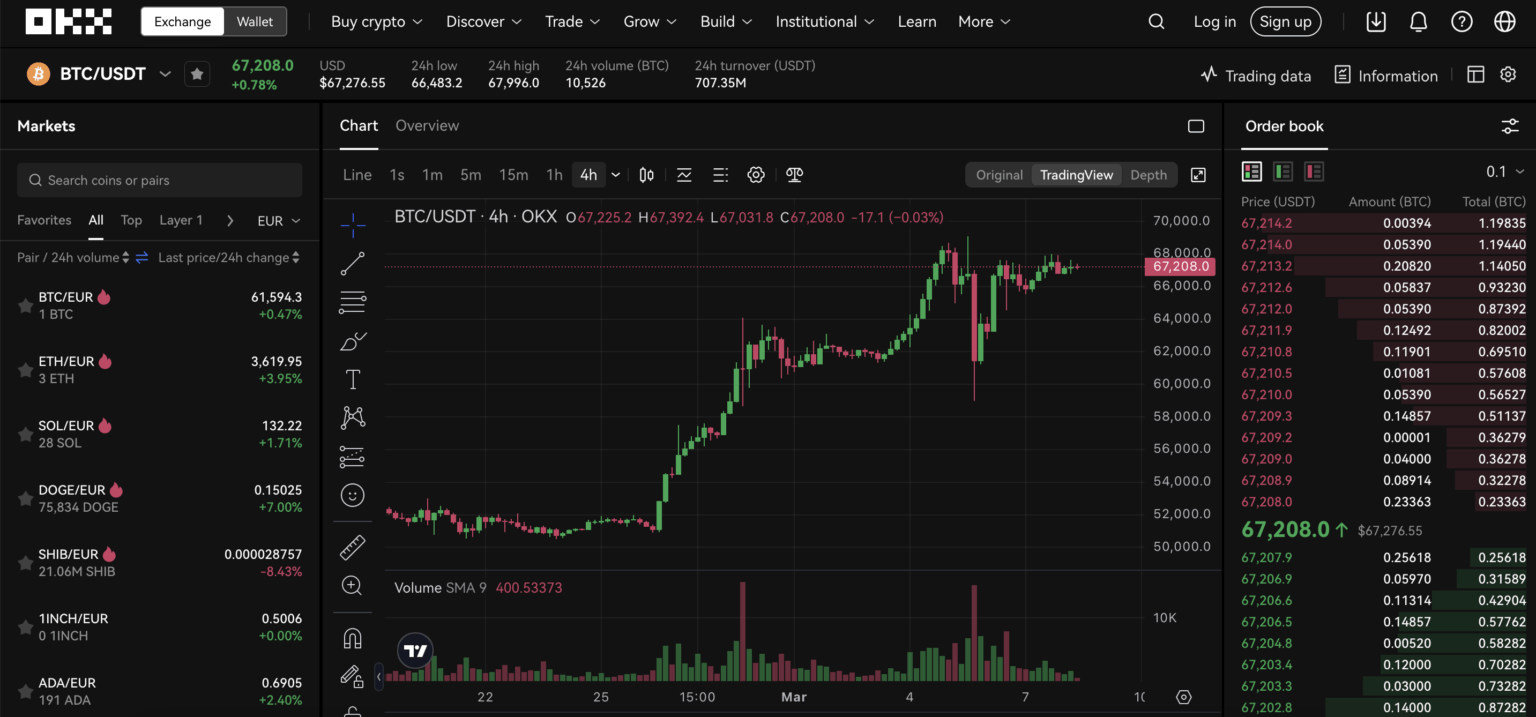
Spot trading is immediate exchange of assets at current market prices. On OKX that means visible order books, limit and market orders, and the ability to use margin (isolated or cross) up to 10x if you choose. Important distinction: spot trading itself does not require leverage, and leverage magnifies both profit and loss while adding liquidation mechanics. Logging in quickly matters because latency and site responsiveness affect the execution of market orders and the slippage you experience during volatile moves.
Decision framework: if you are trading high-liquidity pairs (BTC/USDT, ETH/USDT), execution risk is mostly latency and slippage; for low-volume pairs the liquidity risk is dominant and can widen spreads dramatically. OKX’s recent delisting of several spot pairs (RSS3, MemeFi, GHST, RIO, SWEAT) is a reminder that exchanges prune low-activity listings to protect order-book quality. If you favor thinly traded tokens, expect more delistings and the associated need to withdraw or move positions—something that requires uninterrupted account access.
Login interruptions: costs, contingencies, and best practices
Where it breaks: login failures happen for many reasons — KYC delays, device recognition flags, 2FA loss, or even exchange-side maintenance. Each has different remediation time. Losing access mid-trade is costly; therefore build redundancy: enable multiple 2FA methods (authenticator app plus backup codes stored offline), maintain current KYC documents, and set withdrawal whitelists to trusted addresses. If you use a hardware wallet with the OKX non-custodial Web3 wallet, remember that losing the seed phrase is permanent—this is outside the exchange’s KYC protections.
Trade-offs: convenience versus control. Faster biometric login is convenient but ties access to a single device. Authenticator apps are slightly slower but portable. SMS-based 2FA is convenient in the US but is vulnerable to SIM swap attacks; prefer an authenticator app or hardware keys where possible.
Misconceptions about custody, proof, and on-chain transparency
Myth: « An exchange with Proof of Reserves means my funds are automatically safe. » Reality: Proof of Reserves (PoR) shows on-chain backing of aggregate liabilities but does not eliminate risks like smart contract bugs, governance failures, or the operational risk of a centralized platform. OKX stores more than 95% of assets in multi-signature cold storage, which reduces hot-wallet hacking risk. Still, PoR is a transparency tool, not a panacea.
Why it matters for spot traders: PoR and cold storage reassure that deposits are backed, but active trading requires hot liquidity. If market stress forces rapid withdrawals or large-scale deleveraging, hot wallets and liquidity providers determine whether withdrawals are processed quickly. Expect normal operations to be smooth, but plan for extremes by keeping some capital in a self-custodial wallet if you require absolute access during systemic events.
Practical checklist for a US-based trader who wants to log in and trade spot now
1) Complete KYC ahead of time. Delays in identity verification are common and will stop you from trading or withdrawing during critical moments. 2) Set up and test 2FA (authenticator app recommended) and store backup codes offline. 3) Register device and confirm email so the risk system learns your usual patterns. 4) Fund sufficiently to avoid forced liquidations if you use margin—remember spot positions are different from margin. 5) Keep small amounts in a self-custodial wallet for emergency on-chain activity.
If you want the official login page as a quick bookmark, use this targeted link for convenience: okx sign in. Use it only after confirming the URL’s authenticity; phishing copies of legitimate pages are a common attack vector.
What to watch next (near-term signals and conditional implications)
Watch listings and delistings. The exchange’s recent removal of several low-volume spot pairs shows an active delisting policy; if you trade thin tokens expect occasional delisting notices and plan exits in advance. Monitor PoR updates and security bulletins: sustained changes in reserve reporting or cold wallet procedures can signal shifts in operational risk. Finally, regulatory signals in the US (enforcement letters, guidance on stablecoins or custody) will directly affect KYC and withdrawal rules—these are boundary conditions traders must accept as part of custody on a centralized platform.
Conditional scenario: if regulatory constraints tighten and exchanges must increase onshore custody measures, expect more intrusive KYC and possibly slower account actions during compliance reviews. Conversely, broader acceptance of PoR and standardized audits could reduce some transparency frictions but won’t replace robust personal security practices.
FAQ
Q: What should I do if I lose access to my 2FA device?
A: Immediately use your backup codes (store these offline where they cannot be phished). If you do not have backup codes, contact OKX support and be prepared for identity verification steps; this process can take hours to days depending on evidence you provide. Preventive rule: create at least two independent 2FA methods where the platform allows, and keep recovery material offline.
Q: Is spot trading on OKX safe for US-based retail traders?
A: « Safe » is comparative. OKX employs significant institutional-grade protections (cold storage, PoR, encryption). For retail US traders, safety depends on how you use the platform: small, short-term spot trades in high-liquidity pairs carry predictable execution risk; holding large balances on any CEX requires accepting counterparty risk. A best practice is to split assets between active trading accounts and self-custody for long-term holdings.
Q: How does delisting affect my spot positions?
A: Delisting typically means the exchange will stop new orders and set a deadline for withdrawing or converting the asset. If you hold positions in a pair slated for delisting (as with the recent delistings of several tokens), you should plan to move or sell before the deadline to avoid forced conversions or restricted access. Delisting is not a technical failure but a maintenance of market quality; it imposes operational choices on traders.
Q: Can I rely on browser extension login for fast spot fills?
A: Use the browser extension for Web3 interactions or when you need DApp connectivity. For time-sensitive spot fills, the web platform or mobile app is typically more reliable. Extensions can be slower to restore sessions and are more exposed to local-browser compromises. If you use an extension, pair it with hardware-wallet confirmations for high-value actions.